
Current issue

Our Partners



NEWS
(02/25/2026 / sbr)
Techkon USA expands award-winning SmartInk formulation engine
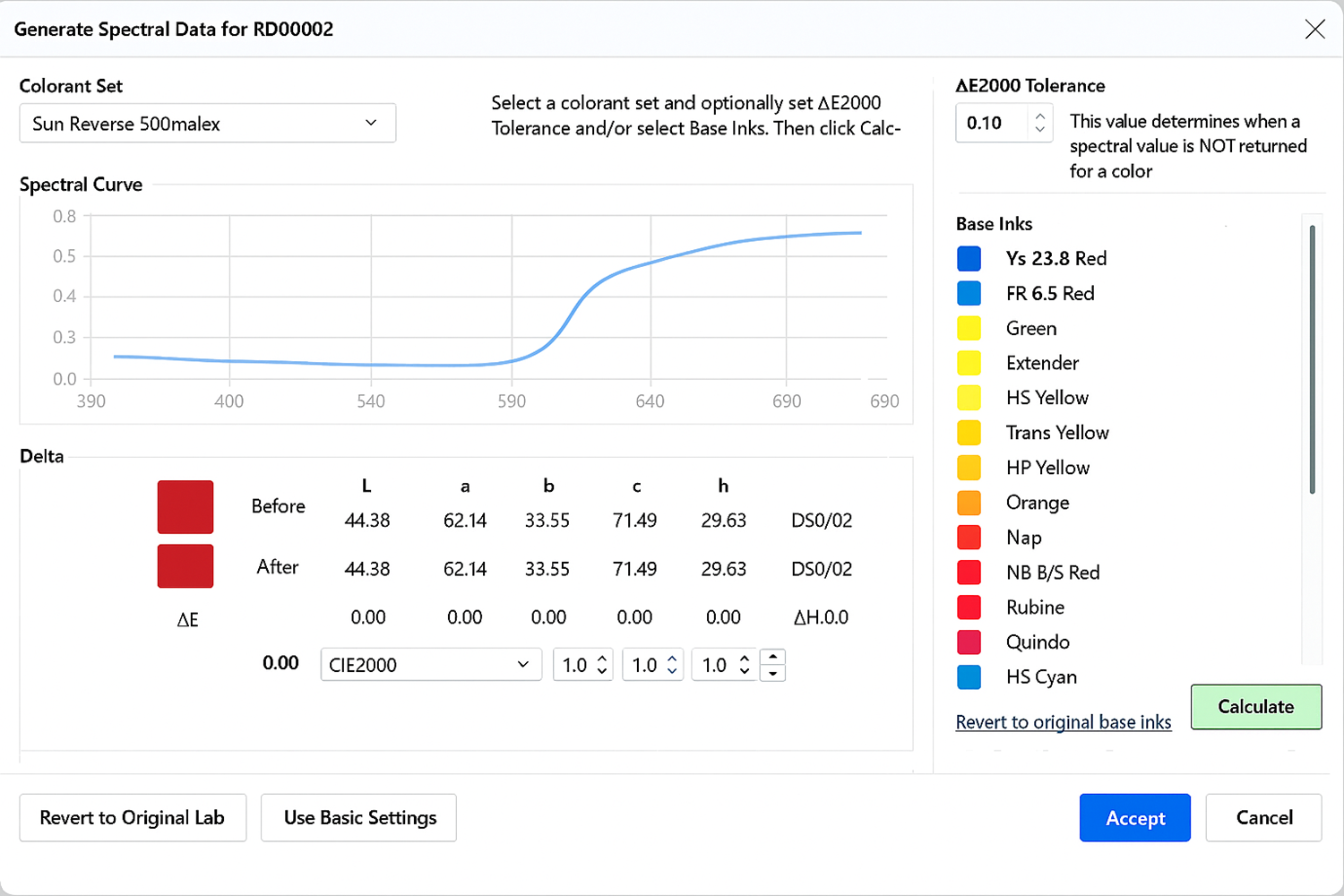
Techkon USA announced that its color QA management suite ChromaQA now can generate accurate spectral data for color standards that are only defined in CIELab values. To ensure the accuracy of this generated spectral data, ChromaQA uses the AI driven SmartInk formulation engine and a colorant set that corresponds to the ink and substrate of the original Lab color standard.
Why are CIE Lab values not sufficient?
CIE?Lab values describe how a color appears to a standard human observer under one specific light source, but they don’t describe the underlying physical behavior of the color. Because of this, two very different pigment mixtures can share the same Lab values — a phenomenon called metamerism. When light changes (e.g., daylight vs. LED), these metameric matches can shift in different ways, causing printed colors that looked identical under D50 to suddenly diverge.
Why is ChromaQA able to create accurate spectral data?
Using the correct colorant set for a color standard defined only by CIELab values is the key to generating accurate spectral data. With the correct colorant set and SmartInk’s AI driven simplified formulation engine, the correct physical material properties of the pigments are uncovered.
What are the benefits of having a full spectral dataset?
A spectral reflectance curve captures the full wavelength behavior of a color. This allows printers and color management systems to predict how a color will behave under multiple illuminants, on different substrates, and with different ink sets.
Benefits include:
- Far better illuminant independent matching
- Strong resistance to metamerism
- Accurate reproduction across CMYK and extended gamut systems
- Reliable press behavior and profiling
For spot color reproduction, ink formulation, and high end workflows (like CMYKOGV or multi illuminant proofs), spectral data is indispensable.
The ability to generate spectral data from CIELab values is just one of a number of new features to be announced in Techkon’s major new update to its color management flagship software – ChromaQA 7, next month.
