
Aktuelle Ausgabe

Unsere Partner





NEWS
(10.07.2026 / sbr)
Google's UCP for Print: Founding partners expand global industry coalition
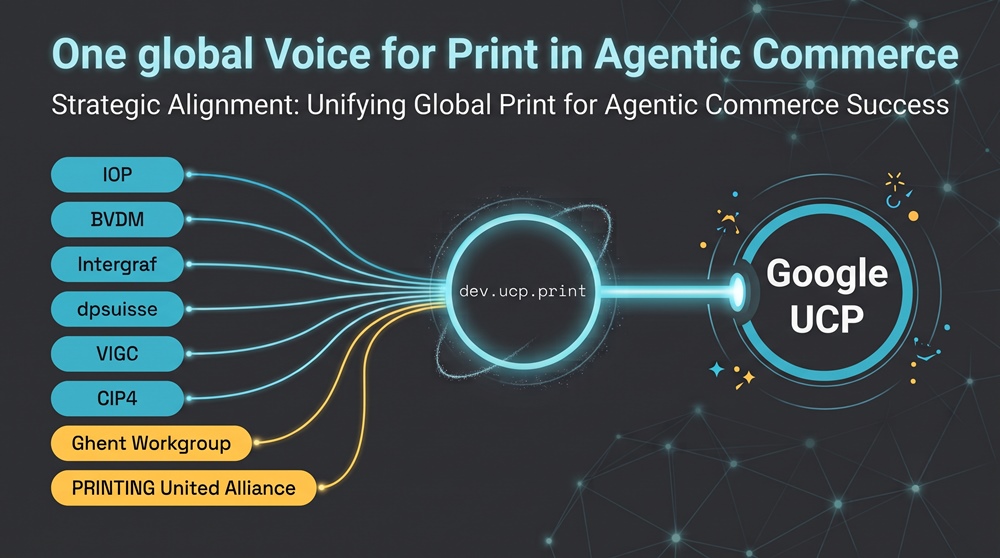
More and more organizations are backing the development of a dedicated print vertical for Google’s Universal Commerce Protocol (UCP), the upcoming standard in AI-powered commerce. With the North American PRINTING United Alliance and the international Ghent Workgroup, two more major organizations are now joining the initiative led by IOP, BVDM, and Intergraf—following the recent additions of dpsuisse (Switzerland), VIGC (Belgium), and the standardization organization CIP4. This European initiative is thus evolving into a global effort aimed at anchoring the interests of the printing industry within Agentic Commerce—and laying the foundation for Agentic Print.
The initiative to develop a print-specific industry standard for UCP was launched in May of this year by Initiative Online Print (IOP), the German Printing and Media Association (BVDM), and Intergraf, the European umbrella organization for national printing associations. As early as June, three additional organizations joined: dpsuisse, the Swiss Association of the Print and Media Industry; the independent Flemish Innovation Center for Graphic Communication VIGC; and CIP4, the international standards organization behind the JDF and XJDF print workflow standards.
According to Bernd Zipper, Chairman of the IOP Board and initiator of the UCP-Print-Dev project, the addition of Printing United Alliance and the Ghent Workgroup now creates the largest industry initiative to date in the international printing industry.
Two heavyweights strengthen the initiative
Printing United Alliance, the most comprehensive member-based printing and graphic arts association in North America, has represented local printing companies for more than 70 years, organizes the Printing United Expo, one of the industry’s largest trade shows, and serves members with leading resources, training, and education, amongst other extensive support. It is now bringing this influence in industrial policy to bear on the UCP initiative as well, citing a clear rationale for its participation: The association views UCP as a strategic move to ensure the competitiveness of the entire industry.
“The way print will be found, ordered, and processed in the future is becoming one of the most critical issues for our industry; and this is not just a technical issue, but one of industry policy,” says Ford Bowers, who has served as CEO of Printing United Alliance—and its predecessor organization, SGIA—since 2016 and oversaw the merger of SGIA, Printing Industries of America, and acquisition of Idealliance to form North America’s largest printing and graphic arts trade association. “An open, fair, and well-regulated commercial environment is in the direct interest of every printing company we represent. We bring the perspective of the North American market to the table, connect UCP with a broader transatlantic audience, and ensure that the commercial and political implications receive the attention they deserve.”
The Ghent Workgroup (GWG) is key player in the standardization of PDF-based print production: Its specifications and the Ghent PDF Output Suite are internationally recognized as the benchmark in prepress, and its members include leading hardware and software companies, print and packaging companies and international educational institutions.
In this way, the GWG addresses a core aspect of the planned print vertical for Google’s UCP, as the automated verification of print-ready data is one of the key requirements that the Universal Commerce Protocol has not yet addressed.
“We are pleased to become part of the dev.ucp.print initiative. Together with the other members, we want to give the global printing and packaging industry a unified voice so that our industries and their expertise are represented in the future development of AI-driven design and procurement processes,” explains David Zwang, who has chaired the GWG since 2008. In the more than 40 years he has spent guiding the industry’s development as a consultant, he has also made a name for himself as a specialist editor, including for the news platform WhatTheyThink.
What UCP Is All About
In January 2026, Google unveiled the Universal Commerce Protocol (UCP) at the National Retail Federation Conference in New York—an open standard that allows AI agents to make purchases on behalf of consumers without opening a retailer’s website. UCP is tailored to traditional retail, which features fixed products and prices. Print products work differently: They are individually configured, require the upload of print-ready data, undergo preflight checks and approvals, and are produced in dynamically scheduled production runs. The current specification does not account for these specific characteristics.
For this reason, the “dev.ucp.print” print vertical is to be developed and incorporated into the UCP standard via a formal enhancement proposal. The target market is substantial: According to Intergraf, the European printing industry comprises around 110,000 companies with approximately 550,000 employees. In North America—dominated by the three core countries of the U.S., Canada, and Mexico—surveys by IBISWorld, Credence Research, Grand View Research, and Revenue Memo indicate there are just under 60,000 companies with around 460,000 employees.
Why Broad Support Matters Now
For the joint UCP project, the growing international support is more than just a symbolic show of solidarity. UCP is an open-source, community-managed standard that explicitly invites contributions from individual industries. It has not yet been launched in Europe. But those who bring their industry’s specific requirements to the table early on will shape how configurable, order-specific products are represented in the protocol. The broader and more global the printing industry’s participation, the greater its influence will be—especially with regard to the submission of an enhancement proposal planned for the fourth quarter of 2026.
As Bernd Zipper explains, no industry outside of traditional retail has yet proposed its own UCP vertical. “With Printing United Alliance and the Ghent Workgroup, we have been able to secure strategically important partners,” explains the initiator of the dev.ucp.print initiative. “Through this project and international support, we’re giving the printing industry the opportunity to play a role in the world of AI-powered commerce—and even to help shape it. Furthermore, the UCP Print Vertical is the first step toward ‘Agentic Print,’ the next stage in the evolution of printing, in which AI agents independently research, configure, order, and pay for print products. For print service providers, this means they must structure their offerings so that they can be found, understood, and processed by AI agents. With an industry-specific vertical for Google’s UCP, we’re providing print shops with the tools they need to do just that.”
